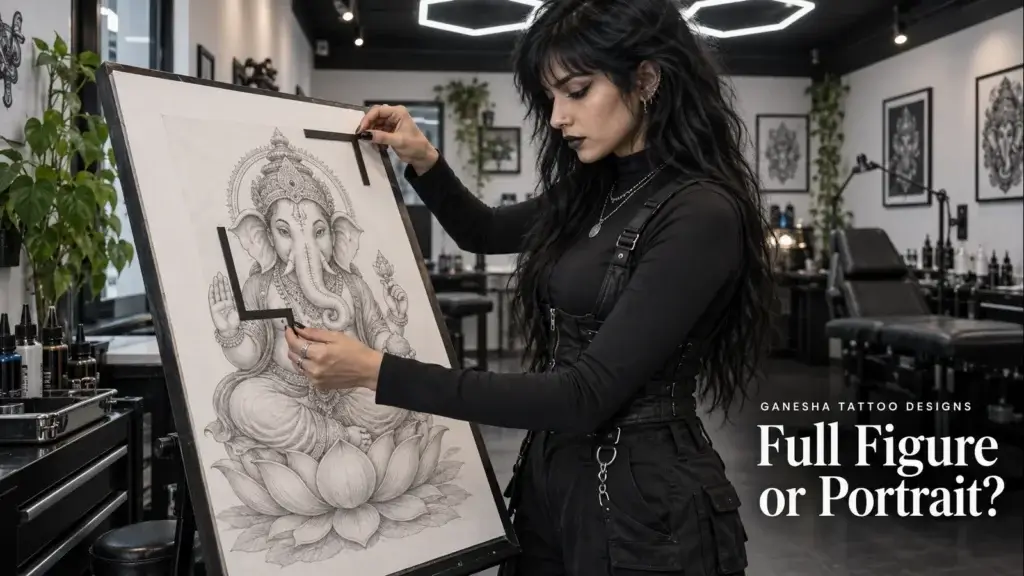
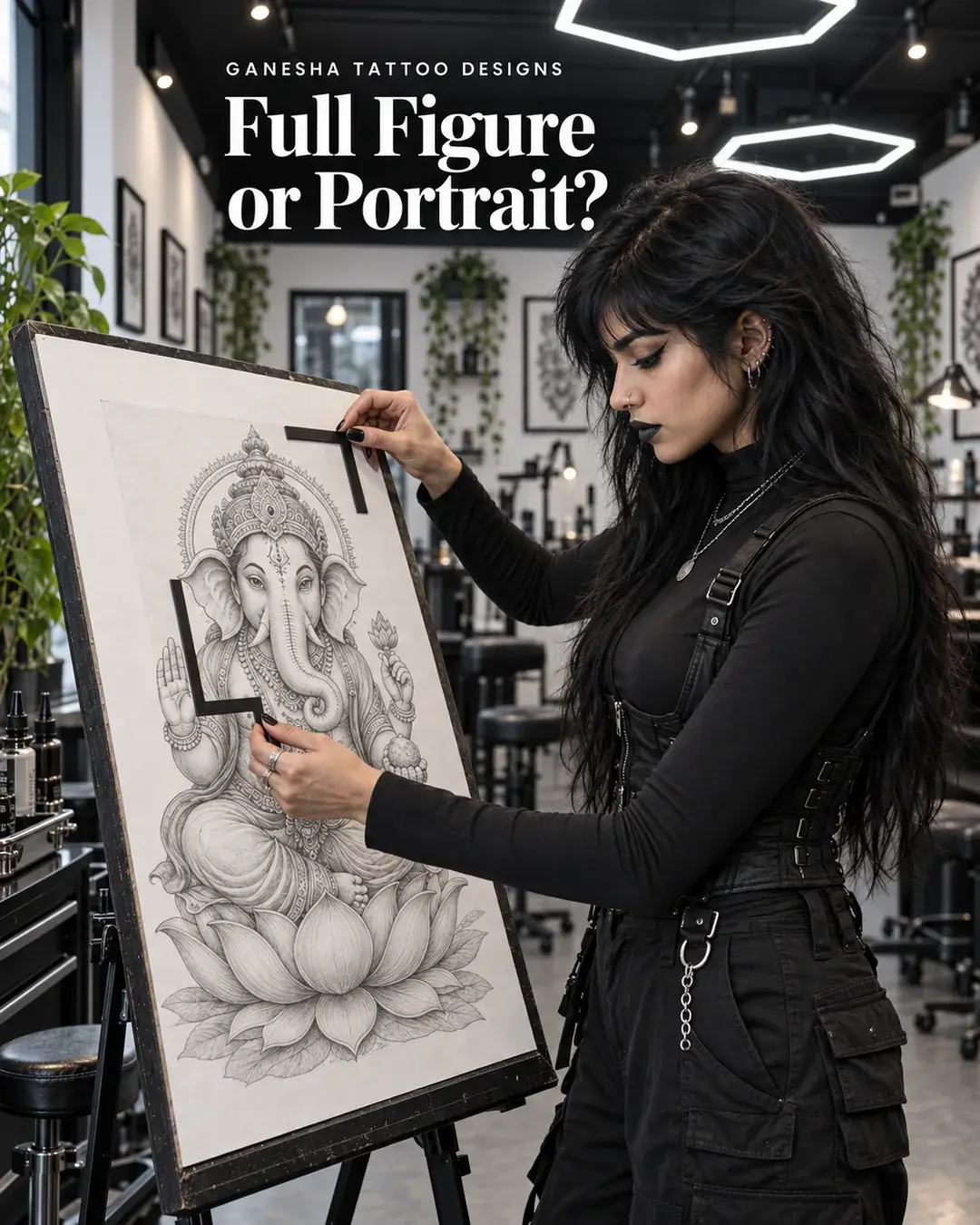
The cover and design-study illustration are AI-generated. The tattoo photographs show real Apex Tattooz work.
Start a Ganesha tattoo design by choosing how much of the subject you want to show. A close portrait gives the eyes, trunk and crown most of the space. A full figure can also include hands, clothing, posture and a lotus beneath the feet. That choice comes before deciding how much extra detail to add.
These two real Apex Tattooz tattoos show different directions. They are separate works, with different compositions and palettes, rather than two versions of the same drawing.
A full figure: the gesture is part of the design

Look from the face down to the lotus. The raised hand, curved trunk, orange clothing and lifted leg all contribute to the pose. The lotus creates a base, while the yellow and purple areas frame the figure.
If the gesture or posture is what draws you to Ganesha, a face-only crop would leave out an important part of your idea. Write down the gesture you want to retain before collecting more examples. “I want the raised hand and the lotus to remain visible” gives the composition a concrete requirement.
Notice how many separate elements occupy this tattoo. A request for the whole figure, every ornament and a very small placement needs a different drawing discussion from a larger upper-arm composition. Decide which elements belong to the main idea and which could be simplified.
A portrait: the eyes and trunk carry the focus

Here, the face occupies most of the photograph. Follow the dark shapes around the eyes and then the curve of the trunk. The crown adds ornament above the expression without requiring a complete body or a separate scene beneath it.
This direction makes sense when the expression and facial form are your central interest. Your brief might be: “Keep the eyes and curve of the trunk as the focus; I like the crown, but I do not need a full figure.” You are identifying what the crop should preserve rather than treating the portrait as a smaller copy of a different tattoo.
Try the crop before choosing the ornament
Use one reference that you like and make a simple viewing comparison on your phone or on paper. Look at the whole image, then consider a crop around the face, crown and trunk. Do not treat either view as finished tattoo artwork; this is a way to find out which part of the subject matters to you.
- If removing the hands and posture changes what you love, keep the figure central to the discussion.
- If your eye returns to the face, a portrait direction may express your idea more directly.
- If the lotus or another supporting element is essential, say where it belongs relative to the face or figure.
Then write a keep-and-optional list. For example: “Keep the face, trunk curve and raised hand. The background ornament is optional.” This separates the features that define your idea from details you merely enjoy in someone else’s photograph.
Palette is a separate choice
The full figure shown here uses colour; the portrait uses black and grey. That does not mean every full-figure design needs colour or every portrait must be monochrome. The photographs differ in more than one way.
First choose the extent of the subject, then consider how you want to express it. If the turquoise face and pink lotus are essential to your preference, include those colours in the brief. If the eyes, trunk and tonal shape are what you want to preserve, explain those instead. The colour and black-and-grey comparison helps you give the palette a deliberate role.
Placement and price belong to your actual composition
Describe the body area and approximate height and width you want to use. A close-up photograph does not tell you the dimensions of another person’s tattoo or establish which version will fit your placement.
The same applies to price: “a Ganesha tattoo” could mean a different amount of drawing and detail in each case. Check the current tattoo pricing guidance for the studio’s rates and estimate process. The two portfolio photographs here are not fixed-price offers.
If a religious attribute or inscription is essential to you, establish the intended depiction and exact wording before the final drawing. A finished portfolio photograph illustrates a visual choice; it does not settle the interpretation you want for your own tattoo.
Choose the part you would miss
Look back at the full figure and the portrait. Which detail would you miss most if it disappeared: the raised hand, the lotus, the eyes or the trunk’s curve? Start there.
For a Ganesha tattoo consultation at Apex Tattooz in Delhi, share that detail, your preferred body area and the reference that explains it. You can explore other subjects in the Hindu mythology collection without losing the specific design preference you have chosen.