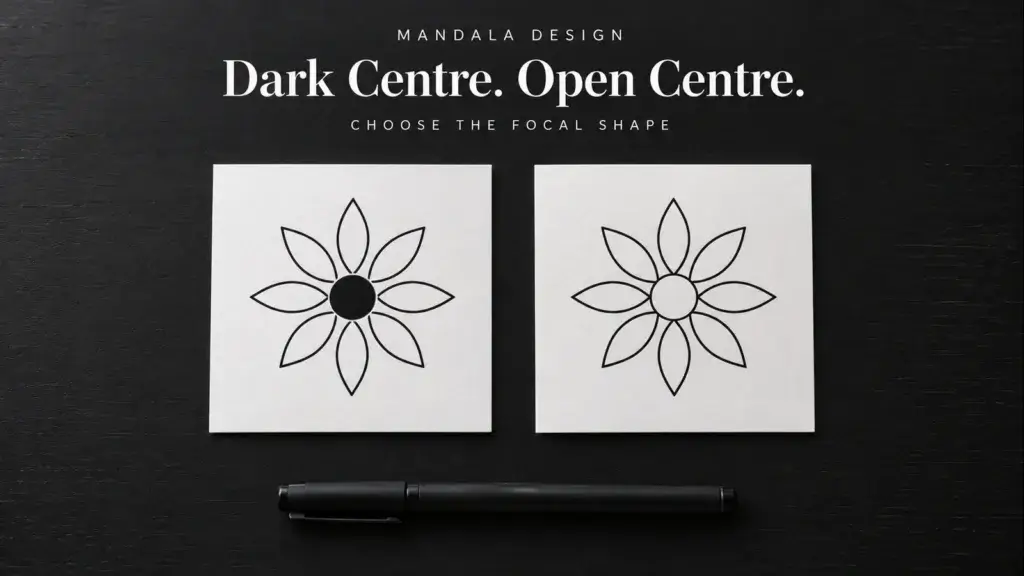
The open part of a mandala tattoo can be one of its strongest shapes. Before choosing how many petals, diamonds or repeated lines to include, look at the middle: do you want an inked shape there, or a shape made by the skin left between the ink?
A dark centre gives the pattern a solid anchor. An open-skin centre lets the surrounding dark shapes define the focal point. Neither is automatically better or more detailed. The useful choice is which relationship you enjoy looking at—and whether it remains clear in the complete design.
The cover and accompanying editorial illustration are AI-generated educational concepts. The two tattoo photographs are existing Apex Tattooz portfolio work.
Read these two tattoos from the centre outward
Start with the centre, follow the spaces immediately around it, then look at the outer pattern. That order helps separate three decisions that can become tangled when you simply ask for “a detailed mandala.” These are different tattoos, not before-and-after photographs or two versions of the same design.
A dark centre, with space around its points
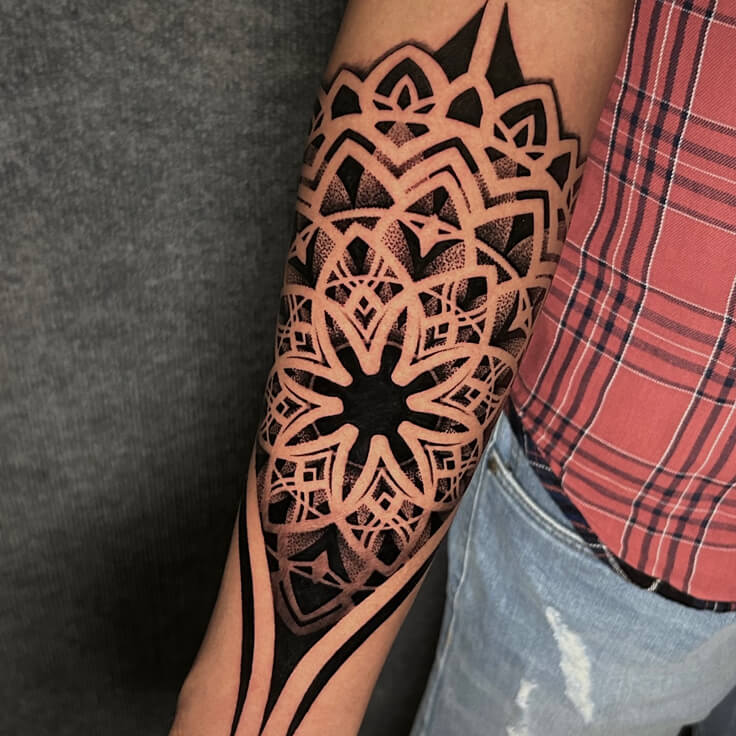
Find the black star-like shape in the lower middle of this photograph. The skin-coloured channels around its points make its outline visible. Farther out, some areas are solid, some contain dots, and others remain open. A dark centre does not require every surrounding space to become equally dark.
Notice how the pale channels continue between the repeated shapes. If you like this example, decide whether it is the solid middle, the pointed petals, the dotted texture or their combination that attracts you. Those details give a designer a much clearer direction than “make it bold.”
An open centre, outlined by dark rays
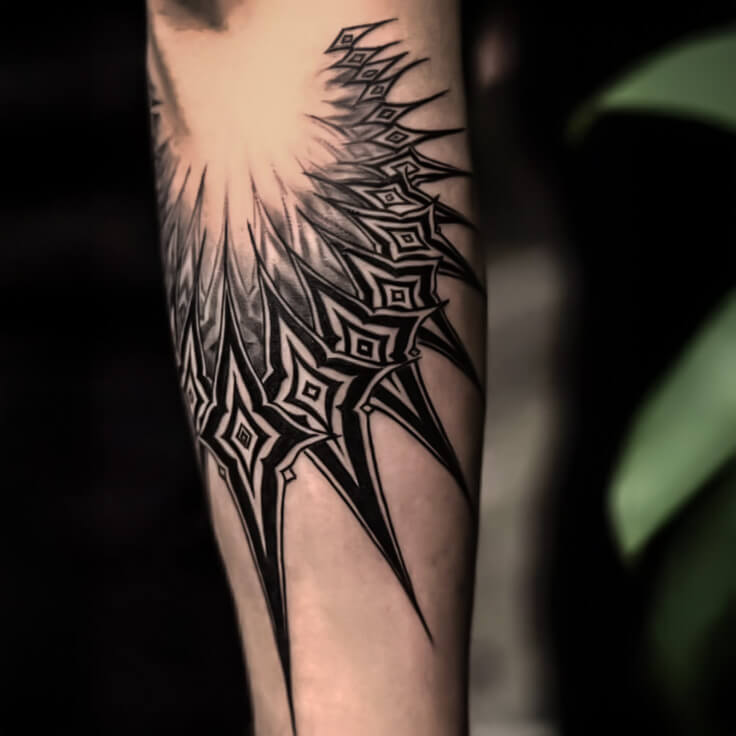
Here, the centre is skin rather than a filled black shape. Follow its boundary: the dark rays point towards it, giving that open area a recognisable form. The nested diamonds carry the pattern outward. The centre is doing visual work even though it contains less ink.
This is what negative space means in this discussion: skin deliberately left visible as part of the design. It is not a request for white ink. The photograph shows one view of a curved arm; it cannot establish how the entire pattern lines up around the body.
Try changing only the centre
Comparing unrelated reference tattoos can hide what you actually prefer. One may have larger petals, more shading and a different placement as well as a different centre. Try a simpler paper exercise before deciding.
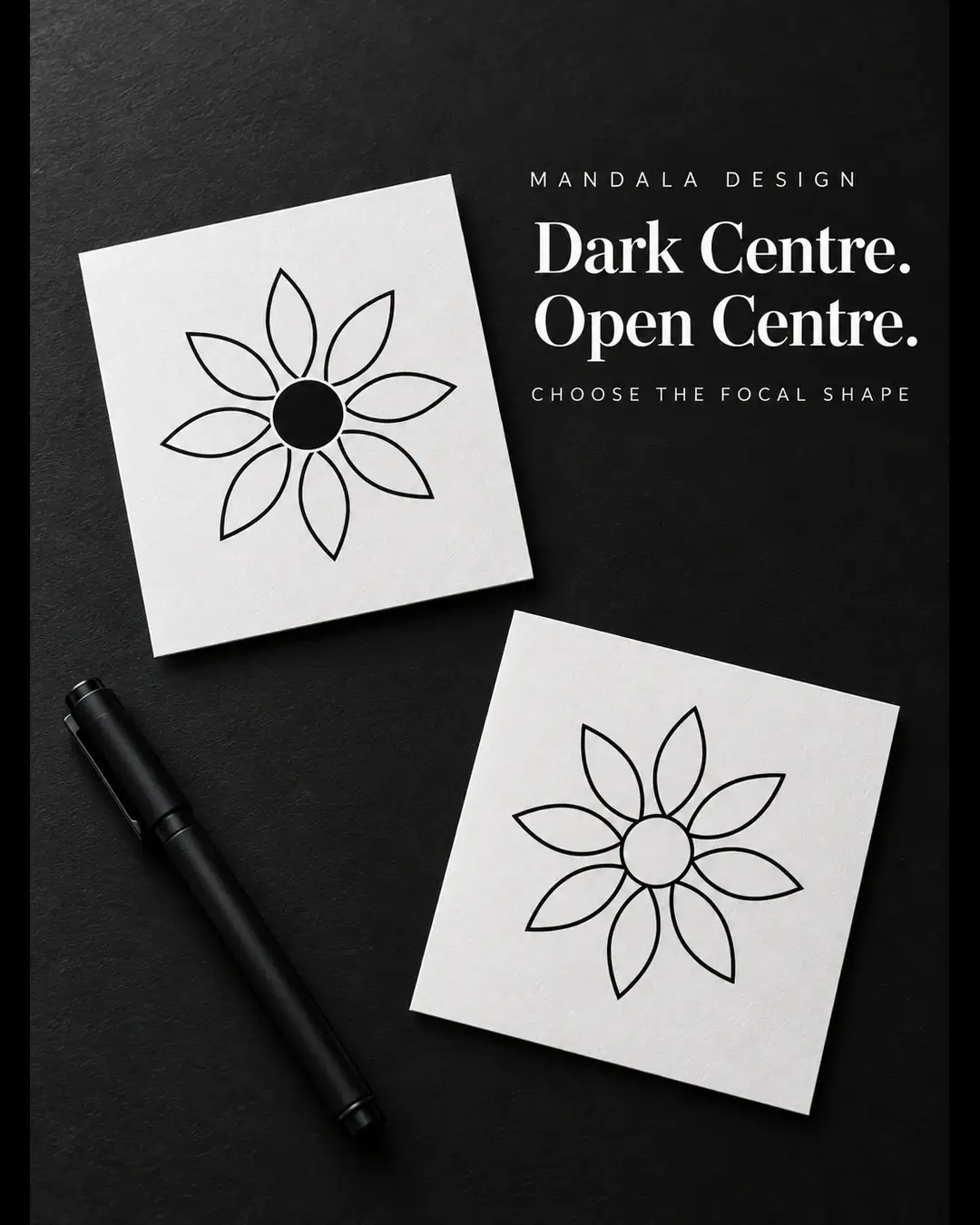
- Draw one easy radial motif. A circle with eight simple petals is enough. Make two copies at the same size, keeping the central-circle diameter, petal shapes and line thickness identical.
- Change one thing. Fill the central circle black on one copy. Leave it paper-coloured on the other. Keep every surrounding outline unchanged.
- Look at the pair from the same distance. Which amount of visual weight do you prefer in the middle, relative to those unchanged petals? Do you enjoy a solid anchor, or prefer the open area held inside the outline?
This is a way to identify a preference, not a finished tattoo design or a test of how it will age. If neither option appeals to you, try changing the centre’s size or its surrounding rays as a separate comparison. Changing those at the same time as the fill would make it harder to tell which choice you liked. There is no need to add more detail just to make either option feel complete.
Separate the centre from the density of the whole piece
An open centre can sit inside a dense outer pattern, as the second photograph shows. A solid centre can be surrounded by generous open channels, as in the first. “Open” and “dark” therefore describe particular parts of the tattoo—not necessarily the entire piece.
Before collecting more references, name the part you would keep and the part you would change. For example: “I like the open centre and long rays in this piece, but I want fewer repeated bands around them.” Or: “I want a small solid centre with clear skin channels separating the petals.” You are describing a relationship, rather than asking for another person’s tattoo to be copied.
Then review the proposed design at its intended dimensions. Zooming in on a phone is useful for detail, but it does not show how the whole pattern occupies your chosen area. The tattoo-size measurement guide explains how to describe height and width. It does not prescribe a universal safe gap or minimum size for every pattern; those decisions need the actual artwork and placement.
If this pattern will connect to existing tattoos, consider its outer edge as well as its centre. Our guide to planning around existing tattoos covers which pieces and spaces you want to preserve. Stencil position is a later, separate review once the design direction is settled.
Bring a preference, not a demand for more detail
For a custom tattoo consultation at Apex Tattooz in Delhi, bring one or two references and identify three things: the centre you prefer, the surrounding spaces you want to keep clear, and the outer shapes you enjoy. Include your proposed body area and approximate dimensions.
You do not need to know the technical name of every shape. “Keep this open area as the focus” is already a useful design decision.