The horns catch your attention. Then you notice the eyes, the teeth, the expression. Before you save another reference, it helps to know which face you are drawn to. A Hannya mask, an Oni-inspired face and a samurai’s face armour have different backgrounds, even when a modern tattoo brings their visual ideas together.
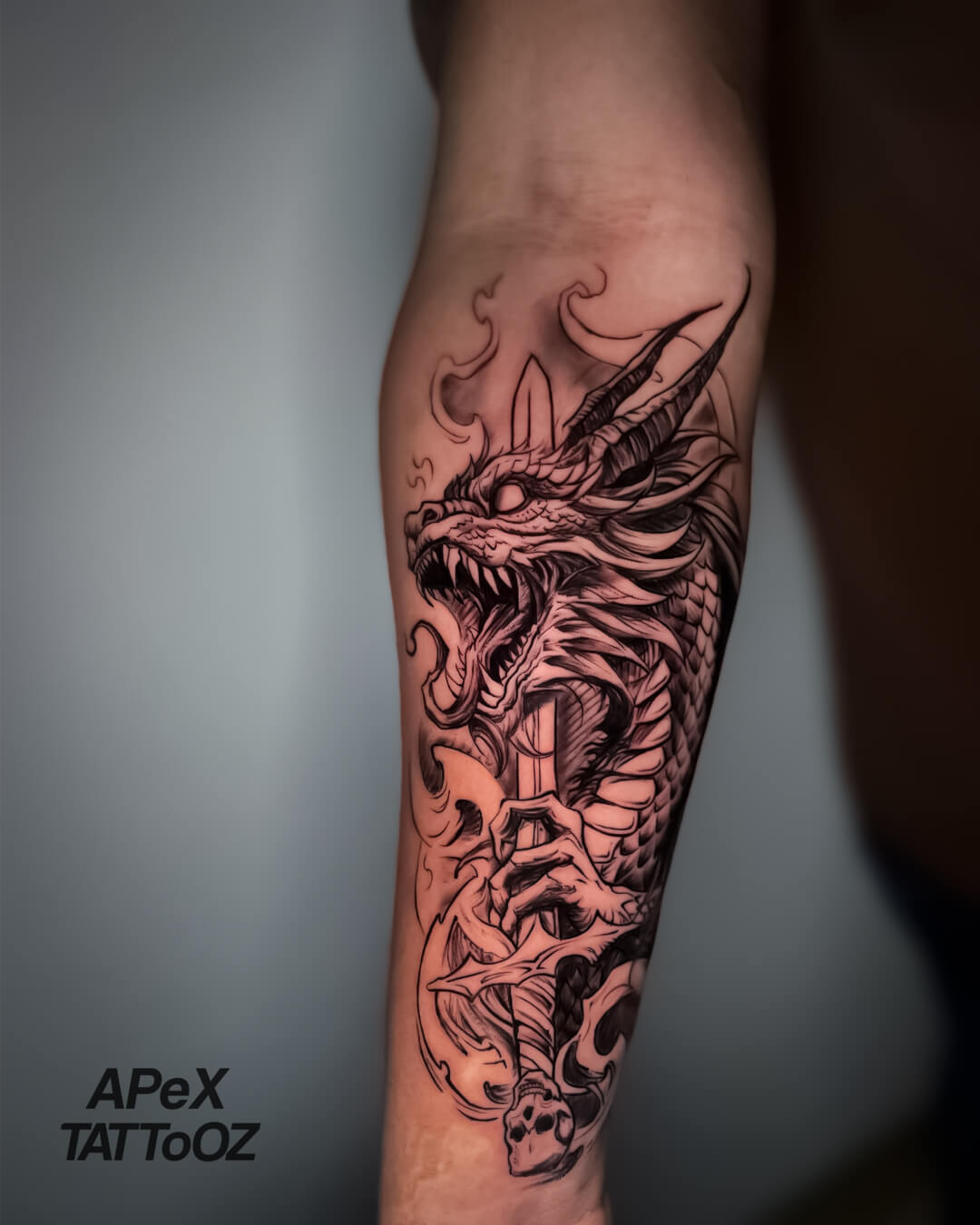
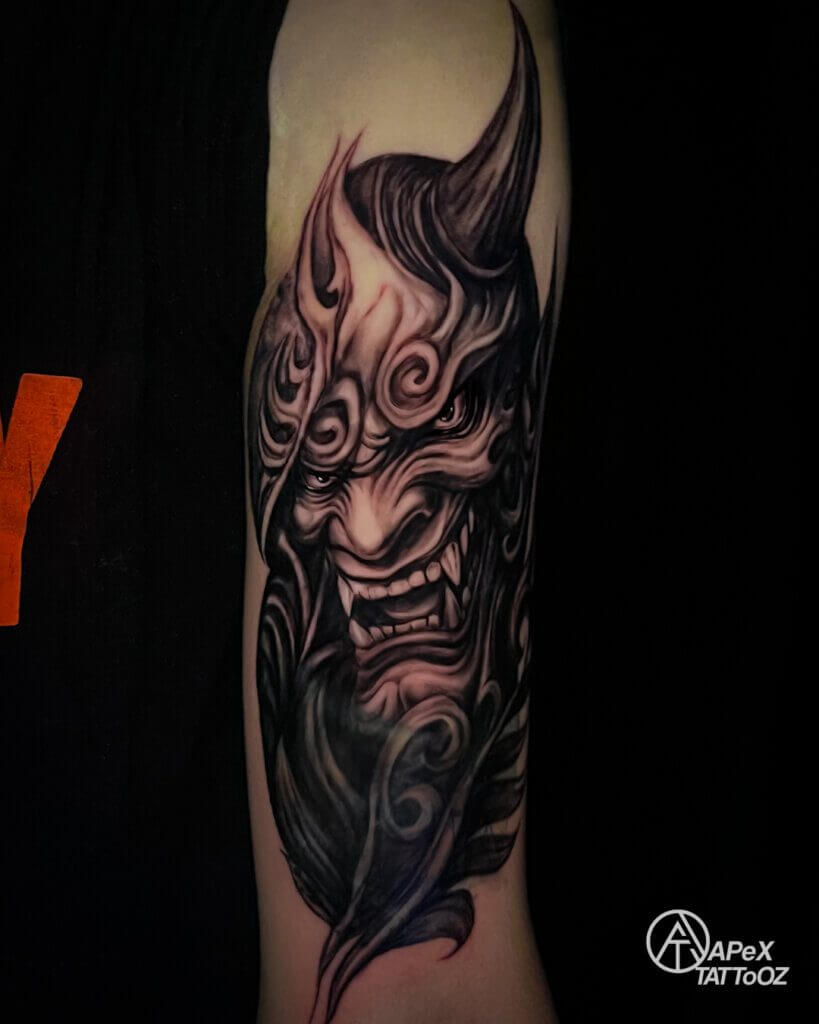
Look at the cover photograph: one face anchors a long, flowing silhouette. The pale brow and teeth stand out against deep black shading, while ornament extends above and below the expression. This contemporary horned-mask interpretation comes from the Apex Tattooz collection.

These photographs show two useful directions before colour even enters the conversation: build the tattoo around one expression, or give the mask companions. If you love the intensity of the face itself, extra subjects are optional.
UNDERSTAND THE FACE
Hannya, Oni and samurai masks: what is the difference?
Hannya is a particular Noh theatre mask; Oni refers more broadly to beings in Japanese folklore; a samurai mask belongs to the history of armour. Those distinctions are more useful than treating every fierce Japanese face as one symbol.
Hannya
In Noh theatre, the Hannya represents a woman transformed by jealous rage. Its expression also carries suffering: the British Museum describes how a change of viewing angle shifts the mask from anger towards distress. Horns, pronounced eyes and an open, fanged mouth belong to its recognisable theatre form. In a tattoo, look closely at the brow and mouth; the emotional character matters as much as the horns.
Oni
Oni is commonly translated as demon or ogre. It is a broader folklore reference, rather than the name of one exact mask design. Japan’s tourism organisation describes demonic figures with varied roles and characters, so reducing every Oni-inspired tattoo to one meaning misses that variety. Bring the actual face or character you like; the label alone leaves a lot undecided.
Samurai mask
Here the starting point is face armour. The Met’s 17th-century menpo is an iron armour mask. Helmet plates, a nose piece, facial protection and lacing can give a tattoo an armoured identity. A contemporary artist may combine those details with an exaggerated face, so a dramatic samurai-inspired tattoo is not automatically a historical replica.
For the Hannya’s theatre context, see also the British Museum’s Hannya collection record. Personal interpretations can sit alongside this history; they should not be presented as the only traditional meaning.
LOOK PAST THE SEARCH LABEL
A red armoured mask and a shaded warrior tell different visual stories.

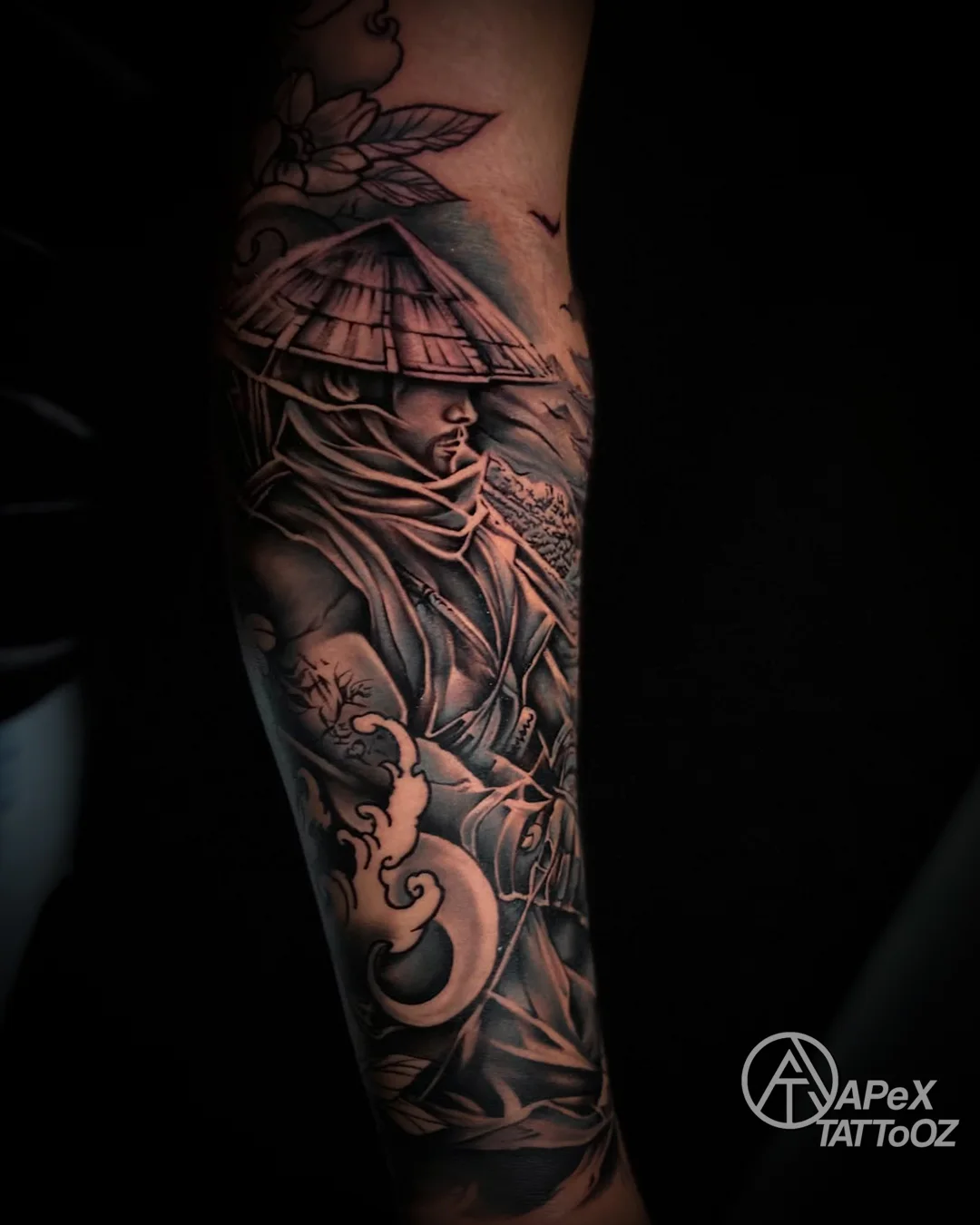
Both references may appear when you search for a samurai tattoo, but they are asking for different things. The colour piece centres an armoured, exaggerated face. The black-and-grey work builds a person through the hat, clothing and surrounding movement. Decide which of those attracts you before asking for a similar tattoo.
Colour is doing a job here.
In the red-mask example, red separates the face from the dark helmet, while orange carries the background down towards the pagoda. In the monochrome examples, bright teeth and facial planes separate from deep shading instead. Think about which feature should stand out, then choose the palette that helps it.
You do not need to add red because the subject is Japanese, or remove it because you prefer detailed shading. A colour accent and an entirely black-and-grey composition are different directions to discuss. Our colour and black-and-grey comparison goes further into that choice.
A snake, skull or flower should have a place.
Return to Maddy’s Hannya composition: the skull sits above the mask, and the snake links the subjects. That arrangement gives the extra elements a purpose. For your own design, decide whether a companion belongs above the face, around it or outside its silhouette. Adding three favourite symbols without choosing their relationship leaves the main expression competing for room.
For a mask-led brief, keep the face dominant. For a larger scene, decide which supporting subject genuinely belongs. You can explore Maddy’s portfolio for more of this layered black-and-grey direction.
MAKE ROOM FOR THE EXPRESSION
Where will the whole face be visible?
A mask has a recognisable relationship between its eyes, nose and mouth. When planning a forearm tattoo, decide which view should show that relationship most clearly. With the arm relaxed, should the face look towards you, towards somebody in front of you, or slightly around the outer edge?
Check the proposed stencil from the front and both sides. If one eye disappears around the arm before you intend it to, discuss the angle or width. The finished photographs above show one view each; your stencil check is where you see how a new drawing sits on your own body.
- Forearm: the tall ornamental mask and stacked Hannya composition offer different ways to use the length of the arm. Choose whether that length belongs to one face or to several subjects.
- Upper arm or a larger area: start with the mask’s width and expression, then work out how background or companions continue around the body. These examples are not a promise that the same drawing fits every placement.
- A smaller mask: simplify the supporting detail before shrinking everything. Keep the expression you want to recognise; decide which scales, curls, teeth or background marks are optional in the new drawing.
- A future sleeve: mention that plan now, so the mask and surrounding areas can be discussed together. A photographed forearm piece does not by itself show a completed sleeve.
For wider placement comparisons, explore the real forearm tattoos in our collection. The stencil placement checklist gives you a practical way to review the drawing before tattooing begins.
FROM A SAVED PHOTO TO YOUR OWN IDEA
Bring the expression you cannot stop looking at.
You do not need to know the perfect historical term before you contact us. Save the reference and point to what matters: the narrow eyes, the open mouth, the helmet or the long ornamental shape. If you want a particular theatre character or historical mask, bring its source too.
A useful starting message could be:
“I like the Hannya’s expression and the black-and-grey shading. I want the face to stay dominant on my outer forearm. I am open to a snake around it, but I do not want a skull. Can we discuss the size and direction?”
That gives the artist an expression, a placement and a clear boundary. Your design can grow from those choices without copying another client’s finished tattoo.
All tattoo photographs here come from the Apex Tattooz studio collection, including earlier projects. They illustrate finished compositions, not verified healed results. View the current Apex team when planning your consultation.